Projects |
Robot Control Through VR
Low-latency VR control system I built to pipe hand gestures through ROS and drive industrial robotic arms.
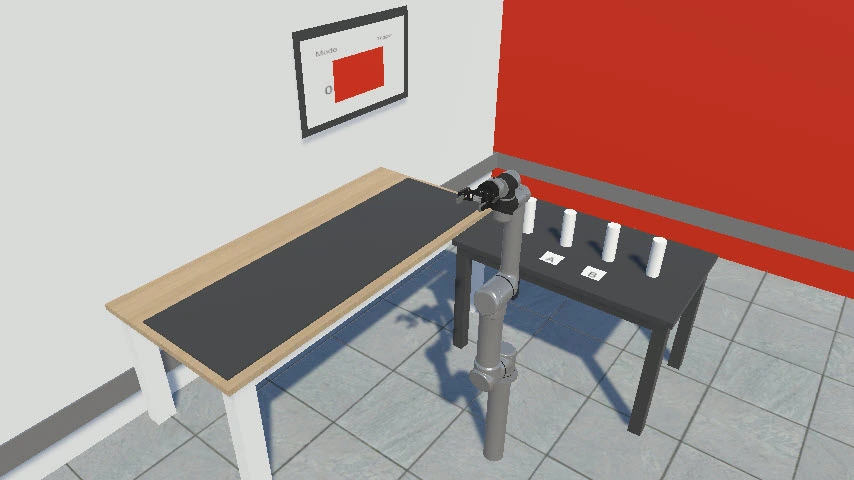
This project explores remote robot manipulation through VR and inverse kinematics. It spans two tracks—real-time mimicry control and data-driven motion playback—to test both direct teleoperation and remote experiment review.
Problem
Industrial robot control is powerful but often intimidating to prototype, especially when operators need both precision and spatial intuition. I wanted to test whether VR could make robot manipulation feel more natural by letting people drive a robotic arm with their own hand and arm movement, without losing the safety and predictability required for real hardware.
My Role
- Built the Unity application, ROS bridge, interaction model, and inverse-kinematics pipeline for VR-based teleoperation.
- Integrated Leap Motion hand tracking, robot joint constraints, and visual overlays so operators could understand what the robot was about to do before committing a motion.
- Later pivoted the project into a motion-replay workflow when physical lab access was restricted during COVID-19.
Live Teleoperation
In the first phase, I built a VR system that lets users drive robotic arms with natural hand and arm gestures. ROS data flows between Unity and the robot over a lightweight network bridge, keeping latency low enough for precise manipulation.
Key Engineering Decisions
- Custom inverse-kinematics solver blends Leap Motion hand poses with robot joint limits to avoid singularities.
- Safety interlocks monitor joint velocity, collision volumes, and operator intent before commands leave the VR client.
- Visual overlays show reachable space and predicted joint poses so users can plan motions before committing.
The core tradeoff was realism versus safety. A one-to-one hand mapping feels intuitive, but physical robots cannot mirror human movement blindly. I treated prediction, constraint visualization, and intent filtering as part of the user experience, not just backend safety logic.
Motion Replay Pivot
When COVID-19 closed the lab, I pivoted to a data-replay pipeline. The interpreter ingests timestamped joint angles from spreadsheets and generates Unity animation clips that reproduce captured robot motion.
What It Proved
- Researchers could review real-world experiments inside VR without needing lab access, making it easier to annotate mistakes and plan retries.
- Demonstrated that low-bandwidth data exports are sufficient to recreate believable robot motion inside Unity—an insight that later guided my remote-collaboration prototypes at UW Graphics Group.
- Helped me think more rigorously about the relationship between embodiment, safety, and observability in XR systems that control things outside the headset.
