Research
Robot Control Through VR
A research prototype for controlling a robotic arm with hand movements in VR, plus a replay tool for recorded lab experiments.
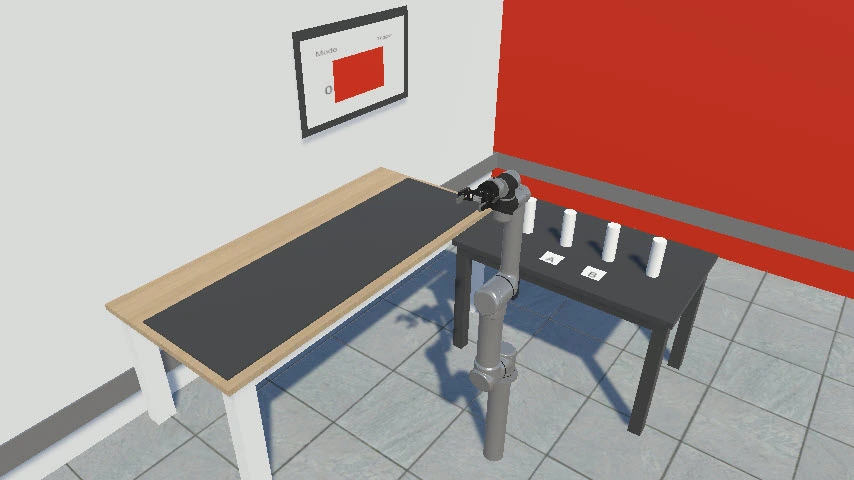
I built the VR side of a robotic-arm research project: first a live control interface, then a tool for replaying recorded experiments. The work covered the Unity app, a ROS bridge, and inverse kinematics.
Making the robot’s movement easier to read
A robot operates in 3D space, but its controls can feel abstract. I wanted to explore whether moving your own hand in VR could make the arm’s motion easier to understand.
The robot couldn’t simply copy a human hand, though, since it had joint limits, collision risks, and movement constraints that the interface needed to make visible.
Live teleoperation
The live interface mapped hand movements to the arm through a lightweight ROS bridge between Unity and the physical robot. I worked on keeping communication responsive enough for deliberate manipulation, while checking commands against the robot’s constraints.

The prototype included:
- A custom inverse kinematics solver combining Leap Motion hand poses with joint limits and checks for mechanical singularities.
- Safety interlocks checking joint velocity, collision volumes, and operator intent before commands left the VR client.
- Overlays showing reachable space and predicted joint poses, so the operator could see the proposed movement before committing to it.
When the lab closed
Once COVID-19 shut the lab, researchers still needed a way to inspect earlier experiments without the physical arm, so I shifted from live control to replay.
I built a pipeline that read timestamped joint angles from more than 15 experiment datasets and turned them into Unity animation clips, which let us reconstruct the recorded motion without a video stream or the original hardware.

Making constraints part of the interface
One-to-one hand mapping wasn’t enough, because when the robot rejected or changed a movement, the operator needed to understand why. That is why predicted poses and visible limits were built into the control interface itself.
When software controls something physical, I believe showing what it plans to do matters as much as accepting the next command.
